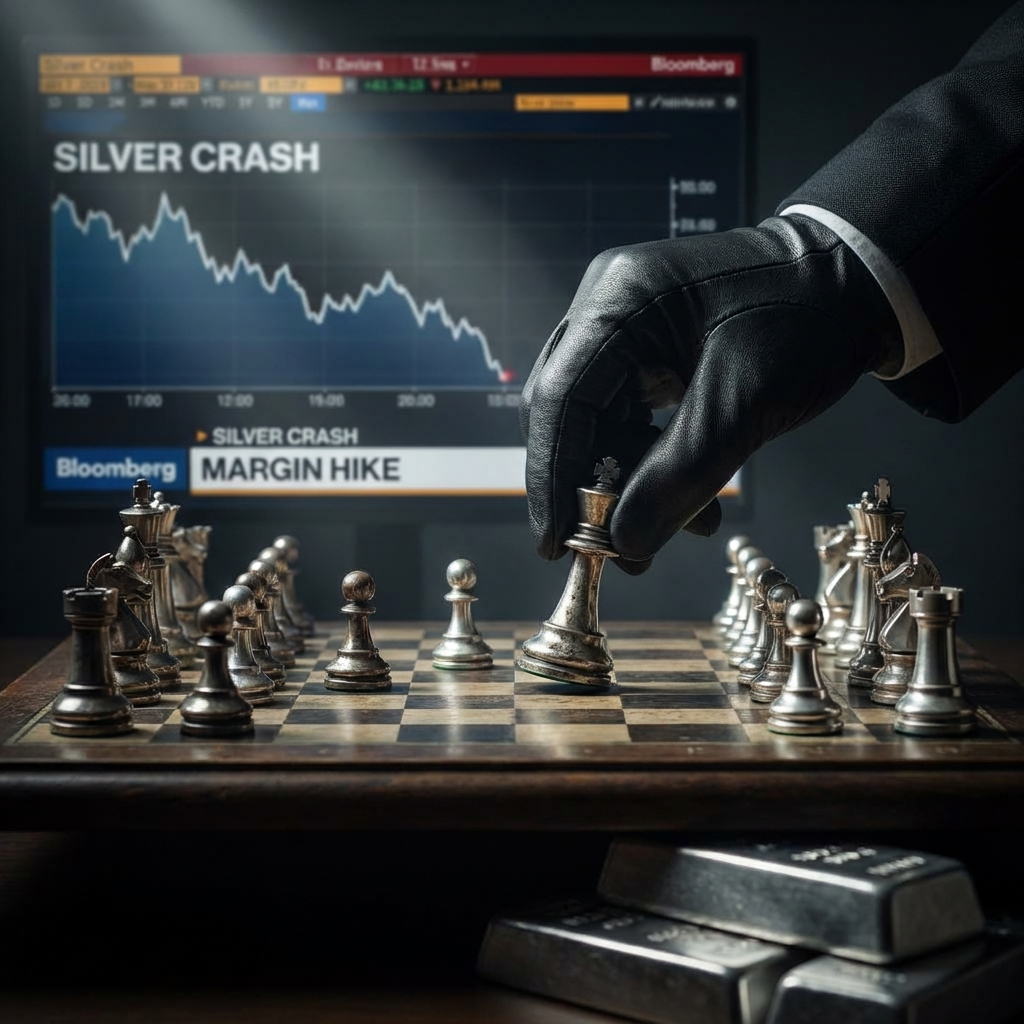
I watched something fascinating happen before the precious metals crash. Hedge funds slashed bullish silver positions by 36% to just 7,294 contracts by late January—the lowest level in 23 months.
While retail traders were still piling in, institutional money was already gone.
The Signal Everyone Ignored
Here’s what I saw that most people missed: there was more paper in the market than actual supply would cover. When CME Group raised COMEX silver futures margins from $22,000 to $25,000 per contract in late December, then again to 15% on January 30th, it wasn’t about risk management.
It was market manipulation. A deliberate forcing of prices lower and liquidation of positions.
Most analysts called this “cooling an overheated market.” I call it what it actually is: exchanges picking winners and losers. They were trying to cool a rally not seen in our times, and in the process, they pulled the rug out from under heavily leveraged traders.
Two Different Games on the Same Field
Sophisticated traders understand when market conditions favor stepping away. When there’s hyper volatility or manipulation, no amount of technical analysis will amount to anything.
Retail traders? They’re still looking at charts and trying to trade the noise.
This isn’t an intelligence problem. It’s an information asymmetry problem. Retail traders have limited access to real market information, real order flow data, and they’ll always be behind the speed of the algorithms. By the time they figure it out, the damage is already done.
Reading the Room
While retail stared at gold charts, institutional money was mapping geopolitical flashpoints. US naval ships moving closer to Iran. Ongoing tensions between Russia and Ukraine. Trump taking over oil in Venezuela.
The rotation into energy wasn’t about diversification. It was about reading where capital would flow next given the geopolitical landscape.
I felt the urge to trade those big moves in precious metals. Those opportunities don’t come around every day. But experience tells you: moves that big and that fast are not natural. You step away and wait for clarity.
What Clarity Actually Looks Like
Clarity means first understanding the true driver of the move. Then ensuring that driver has played out fully.
I watch for institutional flows returning to the market and volatility levels tapering off. Those are positive indicators. Once the margin increase fulfilled its objective, it paved the way for institutional players to resume normal business.
The retail punters were left holding the bag.
The Earliest Warning Sign
Here’s what most people get wrong: they see a big move and scramble to find reasons to justify jumping in.
The earliest tell that something structural is happening? When a market moves at a speed and distance above what’s known to be normal with no obvious immediate reason why.
The absence of a clear catalyst is the red flag.
That’s exactly what I saw right before the precious metals crash—explosive movement without proportional news. Gold dropped 21.2% from near $5,600. Silver lost 41.1% from above $121. The moves were unnatural.
What Retail Traders Need to Understand
You’ll always be on the back foot. As markets move faster and with more venom, this will always be a sore point for retail traders.
But you can survive by adopting a sensible risk management framework, maintaining discipline, and being willing to step away when markets trade out of character.
You can’t win the information game. You can recognize when the game has changed.
The only thing predictable in markets is the unpredictable. Stay humble about predictions while staying disciplined about patterns.
